

Resources
Disclosure of Disciplinary Records
All disciplinary offences are captured in students’ official records with the University. With the exception of notations in transcripts for academic suspensions*, disciplinary records and offences are not indicated in students’ transcripts or degree scrolls, and the University does not provide any information to external parties without the consent of our students. Records will be provided under the following circumstances:
- to law enforcement agencies for the purpose of investigations and legal proceedings;
- to scholarship providers for the evaluation of their existing scholarship holders where the scholarship is administered through NUS; and
- to professional licensing bodies which issue practising certificates upon request (e.g. Singapore Medical Council, Allied Health Professions Council, Law Society of Singapore, etc.).
Within NUS, where there are justifiable reasons, disciplinary records shall be shared. It should be noted that where student consent is provided for the disclosure of student disciplinary history to external parties, e.g. potential employers, universities/schools, scholarship sponsors, etc., ‘Minor’ offences are usually excluded from the reports.
*Transcript notation for disciplinary offences resulting in academic suspensions
With reference to clause 12 of NUS Statute 6 Discipline with Respect to Students, all (interim and final) academic transcripts of student offenders will bear a notation reflecting the period of suspension. At the request of the student, the notation may be expunged from the student’s transcript three years from the date the student graduates from the University and the University may in its absolute discretion decide to allow or reject such a request.
No-Contact Order
NUS may implement No Contact Orders (NCOs) to aid in managing complaints where it is assessed that it is in the interest of both parties to stay away from each other. In the event of sexual misconduct allegations or complaints, the University’s first priority is to address the safety and well-being of the victim. NCOs will be expeditiously served on the accused and the victim to prevent any harassment, intimidation and retaliation between the parties involved. At the same time, the NCOs also serve to preserve the integrity of the University’s investigations. It should be noted that an NCO is not necessarily a finding that a disciplinary offence has been committed, neither does it necessarily form part of any disciplinary sanctions.
Counselling, Rehabilitation & Reconciliation Programme (CRRP)
As educating our students is an important aspect of the NUS disciplinary process, it is imperative that the pathway to rehabilitation and reconciliation for a student sanctioned by the NUS Board of Discipline (BOD) and the Disciplinary Appeals Board (DAB) constitutes a regular and consistent component of sanctions imposed on the students. The Counselling, Rehabilitation & Reconciliation Programme (CRRP) is a framework that brings together several facets for a post-BOD and/or post-DAB protocol, i.e. counselling and psychological assessment (where relevant), serving the sentence/sanction, reflection, reformation, rehabilitation, and reconciliation.
Student Conduct Outreach Talks
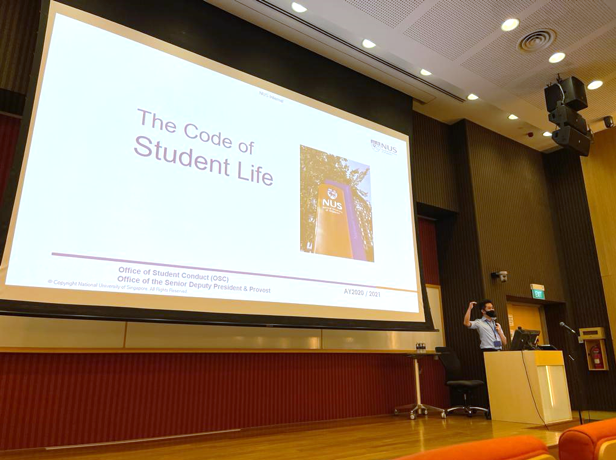
The Office of Student Conduct regularly delivers outreach talks about the NUS Code of Student Conduct and student disciplinary matters during the orientation period of each Academic Year. The talks not only provide information about the common offences committed by students, but also highlight pertinent points in our Statutes and Regulations, emphasise the University’s position on certain types of offences, as well as reiterate the consequences to students for not honouring the NUS Code of Student Conduct. Information is also provided on resources within the University for seeking help and channels for reporting offences.
Education Resources
As a world-class University committed to nurturing an environment conducive for the exchange of ideas, advancement of knowledge and intellectual development, there are fundamental skills and basic information for students to learn and be aware of as they embark on their journey with NUS.
The e-module on SE1000 Student Essentials will allow students to appreciate the importance of maintaining academic integrity and research ethics in their areas of study and research. Separately, the e-module on RC1000A A Culture of Respect and Consent is intended to raise awareness on sexual misconduct and to build a safer campus based on a culture of respect and consent. All new and incoming students into NUS will be required to complete both e-modules and these e-modules are available to all students and staff as resources on LumiNUS.